Tuesday, September 3, 2013

Day 13: part 2 - Kamakura

I wasn't sure what to do with the rest of my day before the concert later that night. I had supposed that I could go to Kamakura either today or tomorrow before the class. It might actually make more sense to go tomorrow sense it was closer to Yokohama, where my dance class would be later that night. Since I couldn't really think of anything to do with my time, I decided that I would go today. Since I was already in Shinjuku, and a direct train to Kamakura left from Shinjuku, it was convenient enough to head out now.

If I were honest with myself, I only went to Kamakura because I felt obligated to go. To be sure, nobody was forcing me or expecting me to go, but I just felt that since I was here in Japan, I should take advantage and see all the typical sites that guide books say I should see. I wasn't very excited to see more Buddhist temples of Shinto shrines, but there was one thing that was unique about Kamakura.

For one thing, it was the administrative center (call it the capital of the country, if you want) during the first shogunate. Military warlords took control of the government in Japan in the late 12th century, and made Kamakura their capital, while the emperor stayed in Kyoto, basically relegated as a spiritual leader of Japan. However, over the past 800 years, little remains of the Kamakura shogunate.

One standout site that does remain, however, is the Great Buddha bronze sculpture. I figured that I should see this. I didn't want to be such a spoil sport, though, and so I went in the opposite direction to see a couple of the other sites on the map, as well. The first site was a Shinto shrine. They are all starting to look the same to me, and this one was not too exciting, except that it had a lily pond of to the side. That was interesting enough to see. Then I went to explore more of the shrine, but I saw that there was an entrance fee. Last week I would have been willing to pay the fee that was the equivalent of a couple of dollars. But not so today.

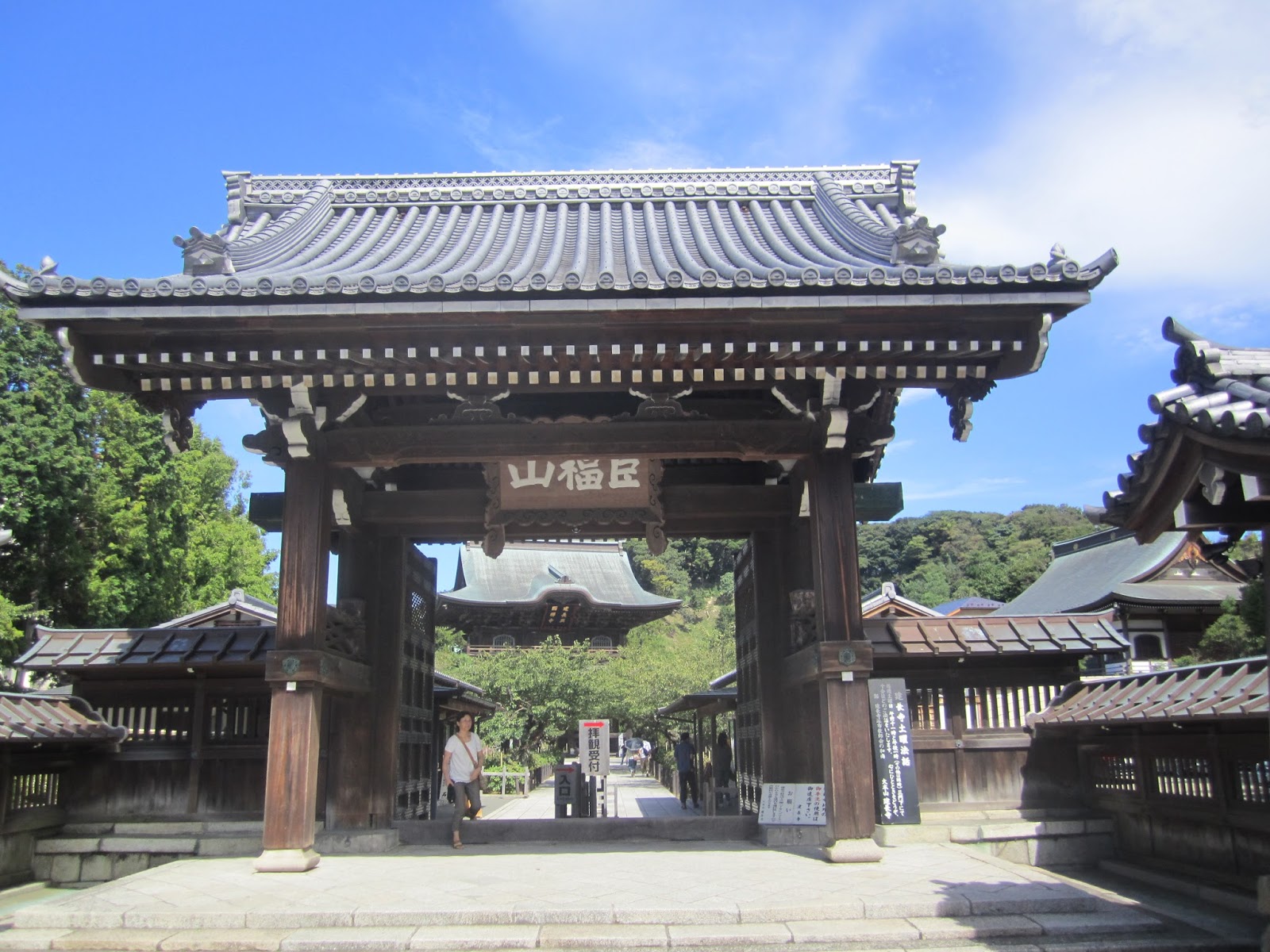
Looking at the map, it seemed that there was a fancy Buddhist temple further up the way, so I made my way up there. The signs that I saw on the street said that it was only a kilometer or so, and that didn't seem like it would be too far. One thing that maps typically don't show, however, is that the kilometer walk was all up hill. The heat was starting to get to me, and my clothes were already soaked with sweat, but before I had a chance to quit and turn around, I was there, and not a moment too soon. I walked up to the temple, and snapped some photos of what I could see from the outside, but again, I wasn't willing to pay the entrance fee, so I quickly turned around and walked back.

Basically, to make it to the Great Buddha sculpture, I would have to retrace my steps all the way back to the train station, then go another mile or so to the temple with the big Buddha. One thing that I've noticed about this trip is that nearly all of the big tourist attraction sites are accompanied by long streets filled with vendors trying to sell souvenirs, or food, or whatever they can to make a buck on the tourist market. To be sure, I don't think that this is a uniquely Japanese feature; places all over the world have been taken over with folks who are trying to make a buck. Even more, I don't think that this is a new feature of human civilzation. I am sure that people were trying to get whatever they can from whomever they can since the beginning of time, and since travel is not a new thing, I am sure that souvenir salesmen are not new either.

By the time I made it to the Great Buddha sculpture, I was exauhsted, but this was one site that I was willing to pay for because it was something different. Again, it was only the equivalent of about three dollars, so it didn't break the bank. I was very tired and worn out when I got there, but I found a shade under a tree, and was able to appreciate the sculpture quietly. I don't know why some things bring a peacful calm over me, but this did, and I felt a bit better. Maybe all this walking was worth it. Even still, though, I did have an appointment in Shibuya tonight to see a dance performance, so after a little bit of rest and relaxation in the Buddha's shadow, I made my way back to the train station to head back to the hotel, take a shower, and go back out.

Day 13: part 1 - Shinjuku

I started the day intending to go to the Japan War Responsibility Center. It is a center that was established by the Japan-China Friendship Foundation, and I thought it would be a good place to research and discuss and gather ideas about how different attitudes in Japan are trying to reconcile with actions perpetrated during World War II.

After my success in finding the performance space the previous night, I thought I would be adventurous, and see if I can make it two for two in finding Japanese addresses. I looked on the website for the location of the space, and even wrote down a couple of phone numbers just in case. That part should have had me a bit hesitant, that there were two phone numbers to write down. One was from their English website, and the other was from the Japanese website. Furthermore, the English website had an address, but the Japanese one did not. I suppose a more intelligent person would have first called to make sure where I was going, and if the place was even open. Well, I'm not a more intelligent person, so I just set out.

I got out at the proper train station and supposed that the location was nearby. I experienced the same troubles finding the address as I did the previous night. But I had time to kill, and I was up for a fun adventure, so it was fine. After about a half hour hunting from here to there, I finally found the address. The ground floor was a grocery market, and I looked up to see if there was a sixth floor; luckily there was, so perhaps I was in the right place.

When I went into the lobby of the building (behind the grocery market), I asked the guy if there was anything in suite 607, but he said there was no suite 607. He looked at the address I had written down, and supposed that it might be the next building over. I wasn't confident that would be the case, but I went anyway. Indeed, it was apartments, and again, there was no suite 607.

Perhaps I had interpretted the address in reverse order, but after finding the other block, I saw that the numbers didn't match up, so... I decided to call it quits, and found an off the kilter bookstore. It was fun to see alternative books and comics and toys that weren't prominently displayed (if displayed at all) at the big bookstores. I found a comic by one of my favorite alternative manga artists, and bought it. I picked this one because it was perhaps one of the more recent ones, and the clerk informed me that it was signed by him. Cool.

Trying to give the Japan-China Friendship Society one more go, I found a payphone near the train station and called one of the numbers. When the person answered the phone, I first asked if she spoke English. She didn't. It is a lot easier communicating with someone face-to-face if they don't speak too much English, and I don't speak too much Japanese, but over the phone, I had no idea where to begin, so I just repeated my decision to quit. I had already found a very informative museum in Osaka that expressed ideas from a similar side of the spectrum, and I wondered if they would be able to give me material that would help my research much, anyway, seeing as how I was illiterate in Japanese.

Day 12: part 4 - Address Hunting in Shibuya

I am still trying to get a hang of how Japanese addresses are situated. It seems that they pick out the city, then the neighborhood in the city which is demarcated by a chome number, then they number the blocks within that neighborhood, then buildings within the block, then the suite number within the building. Perhaps it seems easy enough when I say it like that, but it is challenging to figure out what chome number you are in, and even what neighborhood within a city that you might be in. There are very few signs that actually give this information. What makes it worse is that when you look at buildings, the address is not very prominently displayed, that is, the block number along with the building number.

Looking for the dance venue, I caught a break when I noticed a sign that said that the neighborhood museum, Shoto Museum was this way. That means that this must be the Shoto neighborhood then, right? Well I had nobody to ask or give me the answer, so I just continued on as if it were. The challenge was figuring out what neighborhood number I was in. I was looking for chome 1, but this could just as easliy be chome 2 or 3. I figured that since we were close to the main road, maybe this was chome 1. (Is that how these things are decided?) Then I kept looking for building addresses that might tell me what block number this is. Again, this seems like it would be straight forward, but if you just start numbering across a piece of paper, when do you decide to stop one row of numbers, and then continue numbering on a different row? This is part of what makes this block numbering system rather difficult for me to manage. I am willing to bet that to be a letter carrier, one must study the maps and numbers for quite a long time before he is able to pass some sort of test that makes him eligible to deliver mail. I can't imagine ever passing such a test. (From past experience, it seems clear that taxi drivers are not hip to the system, and cannot even help me find a place that ends up being across the street.)

In any case, I was proud of myself because I finally found the place, and figured out just a little something about the Japanese address system. Very interesting. I looked at my watch and realized that I was more than an hour late for the performance, which probably only lasted an hour anyway. All's well, though, becuase this means that I know exactly where to come tomorrow, right?

Day 12: part 3 - Back in Tokyo

There is going to be a dance performance tonight in Shibuya, but I am not sure that I will be able to make it in time. First I have to leave Yokohama, where the class is. Because of the time I arrived and left Shizuoka, I decided to leave all my bags in a coin locker in Yokohama. That means that I have to pick up all these bags, and then take them to my hotel, check in, drop off the bags, clean myself up, and then make it to Shibuya by the time the show begins at 7. This probably won't happen, but I will try.

I am staying at the same hotel that I was staying at last week while I was in Tokyo. Because of my experience with a private room in Osaka, I was hoping that I would be able to uprgrade to a private room here. In the hotel in Osaka, it was not too much more expensive than staying in the dorm style rooms. Maybe it would be the same here. When I asked, the woman at the front informed me that the private rooms are significantly more expensive than the dorm style rooms. I was considering it for a second, but I decided against it. However, if the same sort of loud people are here this time, I might reconsider. It looks peaceful enough now, though.

Checking in and dropping my stuff off went faster than I expected. Maybe I would be able to catch the dance performance tonight. I took a quick shower and figured that it should only take me about 30 minutes to get to Shibuya. That is not the problem. The main problem is not getting there, but is finding the place. After getting ready, I realized that there was no way that I would make it in time. I was still riding high from the dance class, though, so I decided to go to Shibuya anyway. I figured that even though I would not make the show, I could still find out where the venue was so that I would be able to make it tomorrow. It certainly isn't an exciting adventure, but it is something to do.

Day 12: part 2 - Third Butoh Dance Class

The most surprising parts of this trip have been the Butoh Dance classes. They are surprising because I did not expect to enjoy them so much. Certainly I expected to enjoy visiting friends, and spending time with them, but I thought that the dance classes would simply be an interesting educational experience and little else. However they have inspired many different ideas, and hopefully I can try to manifest some of these ideas and make them happen.

Today I decided that I would have a pen and paper in my pocket the during the class so that I could take notes, and better recall what was said, and what thoughts I had regarding the class. One interesting thing that I noticed was that during my first class, last Sunday, Ohno Yoshito sensei spoke a lot of English. Perhaps he liked me or something, or he wanted to be nice to me. Maybe it was because about half the class was from the west. In any case, this time, he did not speak much English at all, and so I had to understand what he said through a sort of translator. I say that he was sort of a translator because Ohno sensei would talk for a couple of minutes at a time, but when the head dancer translated for me and one other Australian, he condensed everything that was said into a couple of pithy sentences. Clearly I was missing a lot, but if I did understand everything, it might have been too much for me to take in, anyway. Even when the little bit that I did understand (which I think must have been about 10 percent or less), there was still quite a lot for me to absorb. In any case, I will try to translate my notes as best I can below.

The first thing that I understood was Change. Now go. Space is a big problem in dance. What sort of solutions should we arrive at? How can we develop solutions?

The next idea to grasp was that dance is connected to the world. Butoh is connected to world crisis; the dancer cannot be by herself, or isolate herself. To be a dancer, one must feel the tension of the world now. He made a reference to the civil war in Syria, and how the United States might interject its force there. But more then just world crisis, butoh is also connected to everyday life. He told a story about how Diaghelev told Ninjinski to interject more daily life into ballet. How can dance have passion if it isn't related to daily life? We should examine the space for the dance within the context of daily life. This reminded me of GK Chesterton, and how he asks us not to be amazed with things that are uncommon; it is not the solar eclipse that is fascinating, but rather the sun itself is fascinating; earthquakes should not make us tremble, but that there is the earth itself should make us tremble.

Ohno sensei then moved onto the bamboo exercise, reminding us that body and emptiness lead to strength. While dancing with the bamboo, reach high, and reach low. Be heavy, and be light. Dancing with bamboo, he instructed us to dance within the smallest possible space.

He then explained something about the playfulness of children of Brazilian streets. They want a silent night. Then he played the song "Silent Night." This song is mostly about the birth of Christ, but for some reason my mind focused on the resurrection instead. I remember a philosopher made a comment, "If Christ is risen, then nothing else matters. And if Christ is not risen, then nothing else matters." He then took the bamboo away, and told us to continue to dance within the smallest possible space. I tried to dance in the same way I did when I had the bamboo.

Ohno sensei then reminded us that we have to dance as if we are dancing for the audience that is 300 meters away. Wave to a friend who is so far away. Throw him a ball. Nice catch! Then we paired up and on opposite ends of the studio practiced throwing a ball to a far away friend, and catching it. He then illustrated that music makes a difference. He played some electronic music that could have been composed by Xenakis, but I don't know whose music it was, in fact. Then he asked us to dance for someone who is 300 meters away. After that was finished, he asked for an encore, and played what seemed like fast paced tango music, which was a far cry different from the previous Xenakis-like music he just played.

The next lesson was about how butoh and surrealism are related. Butoh likes surrealism. (Or was it realism (which is far different from surrealism)? I couldn't tell through their accents which word they were trying to say. But surrealism makes more sense to me.) In order to get this idea across, he suggested that we dance with our back. Out back is very important. He said that Japanese people care about the back. When you see a person's back, you see her past, and everything about her. Senaka de. Fists down. He said that people could hear Kazuo's soul scream through his back. Also, remember that any moment is a picture, so be cognizant of every part of your body. Open the eye on your back. Here he just had us practice walking down the studio, trying to make our soul scream through our backs. At one point, Ohno sense put a stick into my back. I wasn't sure how I was supposed to respond to this; was I supposed to straighten up more, or let the stick curve my back down? I opted to hunch. But as I saw him do this to other students, they all stayed straight up, so I straightened my hunched back.

For the next lesson, Ohno sensei informed us that palm trees have flowers that come out of their tips. I wasn't sure how accurate this was, or how accurately I understood him, but I went with it. He wanted us to transmit feelings through the tips of our fingers. If we are sad, be sad through the tips of our fingers. He also reminded us that in Japanese culture, if something is hidden, it is beautiful.

Ohno sensei then told us about how Mishima Yukio thought about butoh. Mishima said that butoh shows us what is material. In space you become material. I didn't quite understand what any of that means, but it reminded me of a photo that I had seen of Kazuo Ohno standing up against a wall. When I first saw the photo, I did not understand what the big deal was. Then I showed it to a friend, and he was amazed by his hands and his face, as he had his back against a wall. This photo is what I thought of when I practiced.

The next lesson reminded me of Buddhist readings I have seen. Ohno sensei reminded us that life is composed of good and bad. Life has pleasure, but it has pain, too. There are very rarely times that life is a series of consistent ups. Rather, what we typically experience is a series of ups and downs, in succession. He then tied this back to the earlier idea that butoh is about daily life. While we care about the audience, the most important audience is the audience above, the spirits that are watching you. He gave us a cloth to squeeze. Squeeze the anger you have inside into the cloth. Of course, when you walk on glass, your foot hurts, but when you lift your foot, strength returns. This is daily life.

He then informed us that it is difficult to say something important quietly. One of the more difficult things in opera, Ohno said, was to sing quietly in pianissimo, but still imbue it with passion and gravity and importance.

Omokage. Even after squeezing the cloth, and trying to get out all of our anger, something still remains in the body. It can be seen. So squeeze the body. Even when the music fades out, continue squeezing. Don't fade out quickly. Dance under a full moon.

One of the last things Ohno sensei had to say was that Europeans seemed to not understand Kazuo's dancing. Afterall, he used the same movements whether he was happy or sad. How can we use the same movements if we are happy or sad? Is that daily life? I don't know.

Finally he had us dance Kamihitoe, with a tissue between our hands. This is one of my favorite exercises that we have had here. He then reminded us that the Buddha's smile in many sculptures is very slight. It made me think of the enigmatic Mona Lisa smile. Neither smile is very large or excited, but quite subtle; not so subtle as to not recognize it as a smile.... What are they smiling at with such a smile? Dance.

I had originally thought that by writing notes out, it would help me better remember the class. Indeed, it did. However, as I rewrite it now, I only have more questions, and it seems to make less sense. Perhaps it is not supposed to make sense, but rather help us practice.

(The photos are of new friends from the dance class.)

Monday, September 2, 2013

Day 12: part 1 - Leaving Shizuoka

My friend and his family drove me to the nearest Shinkansen station. It took about 30 minutes to get to, which jives with everything else in this part of the country being a bit more remote. I tried to remember to snap a few photos of the family before we left, but I forgot. I also regretted that I didn't take any pictures of their home or the surroundings while I was there. I think I was a bit nervous about catching the train to Yokohama. He and his daughters did walk me to the train station, though, and that was nice. The younger daughter seemed ot be in a bit of a bad mood. It actually made me feel good that she might have missed me, but I think it is more likely that she was in a bad mood because it was so hot and uncomfortable.

They got me to the train station with enough time to relax before I caught the train. It surprised me that the train ride was scheduled to be 90 minutes long. From Osaka it was about 2 hours, and now another hour and a half just to get to Yokohama (not even Tokyo). This fact told me a little bit more about how nice and out of the way this part of Shizuoka is. It wsa certainly a pleasant and peaceful way to spend a day.

Sunday, September 1, 2013

Day 11: part 2 - Shizuoka with a friend

Before planning this trip, I had reached out to many of my friends who were Japan, and asked if they were free to meet for lunch, or dinner, or a drink, or something. One friend, however, invited me to stay in his home for one night. I felt very welcomed by this invitation, but a was hestitant because I knew that he was very busy with work, and that he had a family with three children. I did not want to be a burden on him and his family. He did seem to insist, however, and so I felt obliged to drop in on my way from Osaka to Yokohama.

He picked me up from the station, and before going to his home, we stopped by the market to get food for a barbeque. Granted, I have not been in Japan very much, but I had never seen so much meat in one place. Although the store had a lot, it was a bit claustrophobic, not because the store was small, but because the aisles that they designed made it seem small. I found it curious that it was basically one long aisle designed like a queue at an amusement park. Everyone had to follow this one path that curved and turned and cornered a round the store, making sure that everyone got a chance to see what they had to offer.

On the way to his home, my friend explained to me the layout of the city. It was certainly a small city in comparison with Tokyo or Osaka, and only had around 80 thousand residents. I looked around to see where these 80 thousand people might be because there were so many rice paddies, tea fields, and other farms that I did not see many people or homes in this quaint town. He informed me that the town was widespread, and so the population density was small. I liked it. He had just built his home last year, and before that the land had never been built upon. His neighborhood seemed very new and quiet with relatively few homes. Right across the street from him was a large hill, so he could be sure that no one would build there. It was a nice, out of the way home.

When we went inside, I met his beautiful family with three children, two older girls, and a boy. The girls were 5 and 4, and the boy was about 18 months. I had a lot of fun playing with them, and enjoyed hearing about their lives since I saw them last in 2007. Having me two friends on this trip (one here in Japan, and one in Los Angeles), it seems that when you buy a house, you become a handiman, perhaps moreso in Japan since new homes are built when you move in. That means that my friend, while he hired a construction firm to build the house, had to build the deck, paint the walls, build a fence, and driveway, and he has hopes to really expand, too. Between seeing the big house on a hillside, happy family (that I am sure has its rough patches), and kids running around, it made me reconsider some of my own choices regarding family and a more sedentary home life.

After the barbeque, my friend took me to a local Japanese izakaya, which is basically a pub. He is clearly an entrenched member of the community, and as he entered, he greeted everyone, and when people came in later, people greeted him. Some of the patrons tried to make whatever conversation they could with me, discussing Japanese literature, or history, or just the neighborhood in general. My friend informed me that since he has been here for more than twelve years, he feels like Japan is home more so than America, where he was raised. Afterall, he has a career, family, and a home here. He told me many things that he liked about being in Japan, such as the fact that people are so much more polite here than in America. Another thing that he appreciated is that new people he meets are generally shy at first, and then open up as they get to know him; he said that he is like this himself. A funny thing he told me is that when he meets people from work outside in the real world, they will generally exchange the minimum amount of pleasantries. However, after a drink or two, people will really open up, and become your best friend. Then when you see them again later, when they are sober, they maintain their reservedness.